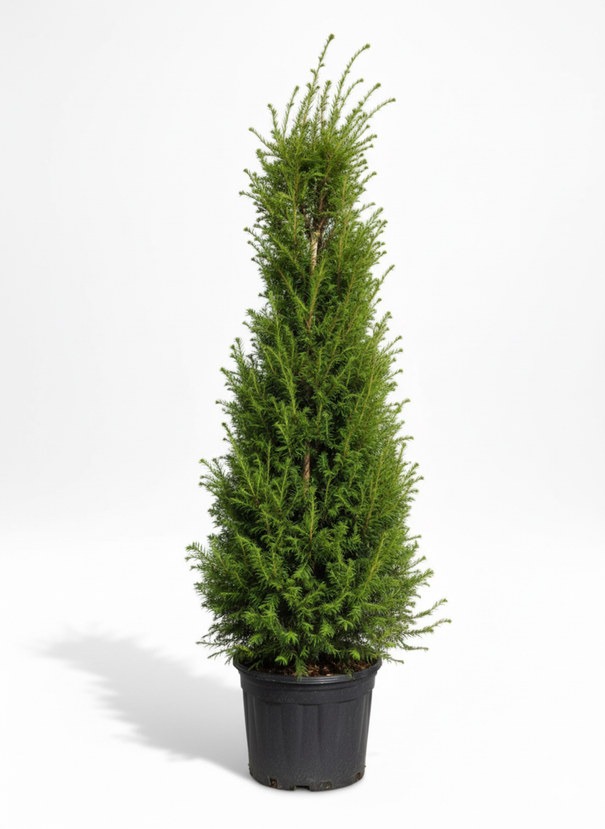
Most of the crisp hedges, pyramids and balls in classic European gardens rely on a single plant: yew. With its dark green needles, dense texture and outstanding response to pruning, Taxus baccata is one of the most dependable materials in formal garden design.
In this guide we cover English yew care and yew pruning step by step. But first, an important warning: yew is a poisonous plant. Be sure to read the safety section below before using it in areas with children or pets.
Important Warning: Yew Is Poisonous
All parts of yew except the red, fleshy cup (aril) surrounding the seed — that is, the leaves, branches, bark and seed — are poisonous to humans and animals. The seed inside the red cup is also poisonous. The leaves remain toxic even after they have dried. Yew also poses a serious danger to livestock such as horses, cattle and sheep, as well as to cats and dogs.
For this reason, care should be taken when using yew near children’s play areas, grazing land and gardens where pets roam frequently. The red arils form only on female plants, and their attractive appearance makes them a particular risk for young children.
- Wear gloves during pruning and maintenance, and wash your hands afterwards.
- Collect and remove clippings so that animals and children cannot reach them.
- Never mix cut branches into animal feed, bedding or grazing areas.
- If ingestion is suspected, contact a medical facility or a vet without delay.
Features of Yew
Yew is an evergreen, long-lived, slow-growing conifer. Its flat, dark green needles are densely arranged along the branches and form an even denser texture the more it is clipped. Unlike many conifers, it can reshoot from old wood, which makes yew suitable both for close clipping and for renovating old plants.
Shade tolerance is one of yew’s greatest advantages. It can grow across a wide range of light levels, from full sun to deep shade, which makes it valuable for places where many plants struggle, such as north-facing sides of buildings, under trees and in courtyards.
Use in Formal Gardens and Topiary
Because yew grows slowly, once shaped it holds its form for a long time. Pyramids, balls and columns are used in formal gardens to create axes, emphasise entrances and build geometric layouts. Columnar (upright) forms provide a vertical accent in narrow spaces and, planted in a row, create the effect of a living wall.
Its dark green texture forms an ideal backdrop for colourful flowers and light-leaved plants. As well as in classic gardens, it is often chosen as simple geometric forms in modern landscapes. Starting with ready-shaped plants lets you achieve the desired look years earlier; you can view the available options on our English yew (Taxus baccata) product page.
Planting: Drainage Comes First
Yew grows in sun, partial shade or shade and is quite tolerant of soil type; it adapts to both chalky and slightly acidic soils. Its one absolute requirement is good drainage. In waterlogged, heavy, airless soils the roots rot; a large share of yew losses happen for this reason.
Before planting, observe whether the site holds water after rain. If necessary, improve the soil with organic matter and coarse sand, or plant in a slightly raised bed. Do not bury the root ball deeper than ground level, water in thoroughly after planting and spread mulch, keeping it clear of the stem. Autumn and spring are the best times for planting.
Watering and Feeding
Newly planted yews should be watered regularly during dry spells for the first year or two. Water deeply when the top of the soil has dried, and let the soil dry slightly between waterings. Established plants are reasonably drought-tolerant. Overwatering is far more dangerous than drought. With container-grown yews, make sure the drainage holes are clear and water does not collect under the pot.
Yew does not need much feeding. A balanced, slow-release fertiliser or a layer of well-rotted compost in spring is usually enough. For frequently clipped topiary, a light feed after pruning can be helpful to support new growth.
Yew Pruning: Timing and Technique
The best time for shaping is mid to late summer; a cut at this time keeps the plant looking neat until winter. On fast-growing young plants, a light preliminary trim can also be done after the spring flush. For formal hedges and topiary forms, one or two trims a year are usually enough.
Use sharp, clean tools. On pyramids and columns, keeping the base slightly wider than the top ensures the lower branches get light and prevents the form from thinning at the bottom. On balls, removing small amounts from the surface each time produces an even sphere. Because yew can reshoot from old wood, renovation pruning is also possible on misshapen or overgrown plants. This should be done in late winter or early spring and spread over several years, cutting back only one side hard each year so as not to exhaust the plant.
Common Problems
Yew is generally a tough plant. Yellowing foliage and branch dieback are usually signs of poor drainage and root problems; check the soil’s moisture first. In spots exposed to cold, drying winds, needle tips may brown in winter. A slight loss of colour in the first year on newly planted yews is usually related to transplant stress and improves as the root system establishes.
Frequently Asked Questions
Is English yew poisonous?
Yes. All parts except the red fleshy cup (aril), including the seed inside the cup, are poisonous to humans and animals. Use it with care in areas with children and pets, and dispose of clippings safely.
When should yew be pruned?
The best time for shaping is mid to late summer. Hard renovation pruning should be done in late winter or early spring and spread over several years.
Does yew grow in shade?
Yes. Yew is one of the most shade-tolerant evergreens. It can grow in sun, partial shade and shade, as long as the soil is well drained.
Does yew grow fast?
No, it grows slowly. This is an advantage for topiary and formal hedging, as it holds its form for a long time and does not need frequent clipping.
At Yalova Güven Fidancılık, English yew (Taxus baccata) is grown on our own nursery grounds in forms ready for formal garden use: 140–180 cm pyramids and balls in CLT 35 and CLT 70 pots (CLT 35 being a 35-litre pot), and upright (columnar) forms in CLT 12.5 pots. You will find our other shaped plants on our Products page. Prices and stock availability are available on request — contact us via WhatsApp or by phone on +90 543 941 88 77.
Yalova Güven Fidancılık
Grown at our own nursery — see forms, pot sizes and heights on the product page.