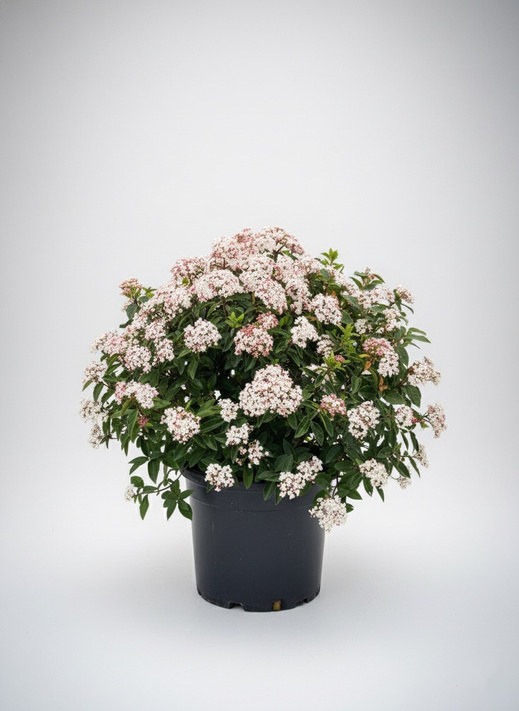
A plant that flowers in winter, when gardens look at their plainest, brings unexpected life to the landscape. Viburnum tinus, known as laurustinus, stands out for exactly this reason: in late winter and spring it opens creamy-white flowers from pink buds, and it keeps its glossy dark green leaves all year round.
Thanks to its toughness, good response to pruning and dense habit, Viburnum tinus is one of the most popular choices for anyone looking for a hedging plant. In this guide we cover viburnum tinus care from planting to pruning and offer practical tips for using it in hedges and borders.
Features of Viburnum tinus
Viburnum tinus is an evergreen shrub native to the Mediterranean basin. Its oval, glossy, dark green leaves resemble those of bay laurel, which is where its common name laurustinus comes from. It forms a densely branched, full shape and, left to grow naturally, takes on a rounded outline.
The plant’s most striking feature is its long flowering period. Pink buds appear from autumn onwards and open into flat clusters of creamy-white flowers through late winter and spring. With the pink of the buds and the white of the open flowers visible at the same time, the plant stays decorative for a long period. Small dark blue-black berries may follow the flowers.
- Evergreen, glossy dark green leaves
- Creamy-white flowers from pink buds in late winter and spring
- Dense, full growth habit
- Adapts to sun and partial shade
Use as a Hedge and Border Plant
Thanks to its dense foliage, Viburnum tinus suits both regularly clipped formal hedges and looser natural hedges. It is often used to create a privacy screen along neighbouring boundaries, to separate areas in residential complex gardens or to soften the base of walls.
It also performs well in borders and mixed shrub groupings. Because it flowers in winter, planning it alongside summer-flowering plants keeps the garden interesting at every time of year. For your landscape projects, take a look at our Viburnum tinus product page.
Planting: Position and Soil
Viburnum tinus grows happily in full sun and partial shade. It tends to flower more freely in sunny positions; it also grows healthily in partial shade, so it can be considered for under trees or the shaded sides of buildings.
It is not very fussy about soil, but prefers soil that drains well. Because root problems can occur in heavy soils where water stands for long periods, it helps to add compost and coarse sand to the planting hole.
Container-grown plants are best planted in autumn or spring. Dig a hole roughly twice the width of the root ball, set the plant at the same level it sat in the pot and water it in thoroughly after planting. When planting a hedge, spacing the plants evenly along a line gives you a continuous green wall within a few years.
Watering and Feeding
Newly planted shrubs need regular watering throughout the first year, especially in summer. Watering deeply when the top layer of soil has dried encourages the roots to grow deeper. Once the root system is established, Viburnum tinus is reasonably drought-tolerant; even so, occasional deep watering during long, hot, dry spells helps keep the plant looking its best.
Its feeding needs are modest. Spreading well-rotted compost over the root zone in spring, or using a balanced, slow-release fertiliser, is usually enough. Mulch over the root zone both retains moisture and reduces weeds.
Pruning and Maintaining the Form
The best time to prune Viburnum tinus is straight after flowering, in late spring. Because the plant forms the following winter’s flower buds through summer and autumn, hard pruning in late summer and autumn can reduce flowering.
On formal hedges, a light tidy-up can be done in early summer in addition to the main post-flowering prune. Keeping the hedge slightly wider at the base and narrower at the top ensures the lower branches get light and the hedge does not thin out at the bottom. Old plants that have become bare inside can be rejuvenated with gradual renovation pruning spread over several years.
- Main pruning: straight after flowering
- A light tidy-up of formal hedges in early summer
- Avoid hard pruning in late summer and autumn
- Remove dead and diseased branches at any time of year
Winter Hardiness, Problems and a Safety Note
Viburnum tinus usually comes through winter without trouble in mild and coastal climates. It is moderately cold-hardy; in harsh continental climates it is a good precaution to protect young plants from cold, dry winds and to cover the root zone with mulch.
Although generally a healthy plant, pests such as aphids, whitefly or viburnum beetle may occasionally appear. Constantly wet soil can lead to root rot. Regular checks and early intervention solve most problems before they grow.
A safety note: the plant’s dark berries should not be eaten; they are reported to cause stomach upset if swallowed. Keep this in mind in areas frequently used by children and pets.
Frequently Asked Questions
When does Viburnum tinus flower?
Pink buds appear from autumn onwards, and the creamy-white flowers open through late winter and spring. Its long flowering period makes it valuable for winter gardens.
Is Viburnum tinus suitable as a hedging plant?
Yes. Being evergreen, dense and responsive to pruning, it is very well suited to both formal and natural hedges.
Does Viburnum tinus grow in shade?
It grows healthily in partial shade. It tends to flower more freely in full sun; in very deep shade, flowering may decrease.
Are Viburnum tinus berries poisonous?
The berries should not be eaten; they are reported to cause stomach upset if swallowed. Make sure children and pets cannot reach them.
At Yalova Güven Fidancılık we have been growing Viburnum tinus on our own nursery grounds in Yalova since 2005, and we supply it in CLT 18 (18-litre) pots. For your hedging and border projects, you can find product details on our Viburnum tinus product page and other plants on our Products page. Prices and stock availability are available on request — contact us via WhatsApp or by phone on +90 543 941 88 77.
Yalova Güven Fidancılık
Grown at our own nursery — see forms, pot sizes and heights on the product page.