Shaped plants, or topiary, can change the character of a garden with just a few pieces. A well-chosen pair of spiral standards makes a doorway inviting; a row of balls makes a simple terrace look orderly and well kept. One of the plants most often used in these schemes is the Euonymus japonicus cultivar ‘Bravo’.
In this article we look at ‘Bravo’ as a design material: which form works where, how to use it at entrances and on terraces, how to choose containers and companion plants, and the basic care needed to keep the design intact for years.
What Makes Euonymus japonicus ‘Bravo’ Stand Out in Design
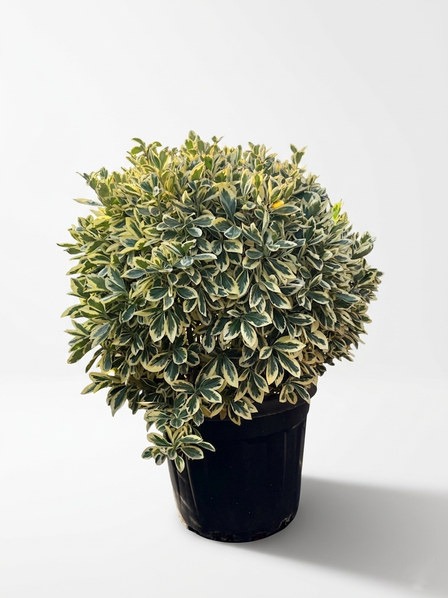
‘Bravo’ is known for its glossy green leaves with irregular cream-coloured margins. This fine, pale edge gives the plant a bright, clean look from a distance. Because it creates a cooler, more refined colour effect than yellow-toned cultivars, it fits easily into modern, minimalist and classic designs alike.
Being evergreen, it keeps the design together through the winter months. Its dense branching and good response to pruning are the two key qualities sought in topiary. It is moderately cold-hardy; in harsh continental climates, winter protection should be considered, particularly for container plants.
- Foliage: glossy green with irregular cream margins, evergreen
- Forms: ball, pyramid and spiral-stem standard
- Safety: parts of the plant, especially the fruit and seeds, can cause poisoning if swallowed; take care where children and pets can reach it
Which Form Works Where?
Each topiary form adds a different language to a space. When choosing a form, consider the scale of the space, the key viewpoints and the overall style of the design together.
- Ball form: Gives a soft, balanced effect. Repeated along a border it creates rhythm; it is also used in containers and along the edges of steps. Small sizes suit windowsills and balconies, while larger sizes work as focal points within the garden.
- Pyramid form: Creates a vertical line and makes a space look taller than it is. It provides a strong accent in corners, in front of walls and in symmetrical entrance schemes.
- Spiral-stem standard: The twisting trunk and rounded crown make the plant look almost like a sculpture. It is most effective when used sparingly and is ideal beside doors and as a focal point on a terrace.
Entrance Design: Making a First Impression with Plants
The entrance to a home, office or residential complex is the first thing a visitor sees. A spiral-stem standard Euonymus ‘Bravo’ placed on each side of the door brings a sense of order through symmetry and frames the entrance. The space beneath the stem lets you add low seasonal flowers or trailing ground cover to the surface of the container.
Wider entrances can take a layered arrangement: pyramids at the back with lower balls in front. This stepped structure adds a sense of depth. At residential complex and hotel entrances, repeating the same form creates a corporate, well-maintained look.
The thing to watch at entrances is light. ‘Bravo’ does well in full sun and partial shade, but in corners under a porch roof that get almost no light it may thin out over time.
Container Topiary on Terraces and Balconies
Because planting space on terraces is limited, topiary is mostly grown in containers there. The container is part of the design: anthracite or concrete-look planters bring out the cream edges of ‘Bravo’, while terracotta pots give a warmer, Mediterranean feel.
The container should suit the plant’s root volume and have drainage holes. On windy upper floors, choosing pots with heavy bases prevents tall standards in particular from toppling over. Using ball-form Euonymus ‘Bravo’ spaced at intervals around a seating area on a terrace draws a light boundary without closing the space in.
As companion plants, lavender, rosemary, ornamental grasses or seasonal flowers add a soft contrast to the geometric lines of the shaped plant.
Basic Care to Keep the Design Intact
Topiary is not something you set up once and leave; keeping the shape crisp depends on regular, light trimming. The main pruning is done in spring once the risk of frost has passed, and stray shoots are tidied once or twice over the summer. On spiral standards, keeping shoots short where they grow into the gaps between the twists keeps the spiral line legible. Shoots arising from the trunk and the roots should also be removed so they do not weaken the crown.
Variegated cultivars occasionally produce all-green shoots; these should be cut out as soon as they are noticed. Container plants need more frequent watering in summer, but water should not be left standing in the saucer. A slow-release balanced fertiliser applied in spring is usually enough for growth.
Powdery mildew and scale insects are among the most common problems on Japanese spindle. Leaving space between plants for air circulation and checking the branches regularly make early intervention easier. In cold regions the roots of container plants are more easily damaged by frost, so wrapping the pot in winter and moving it to a sheltered corner helps.
Frequently Asked Questions
What is a spiral standard?
It is a shaped plant whose trunk rises in a spiral twist, topped with a rounded crown. Because of its decorative look, it is usually used beside doors, on terraces and as a focal point.
Can Euonymus ‘Bravo’ be grown in a container?
Yes. It grows successfully in a container with drainage holes that suits its root volume, using a free-draining potting mix. Container plants should be watered more often in summer and protected in winter in cold regions.
How often should topiary plants be trimmed?
In most cases, one main pruning in spring and one or two light touch-ups over the summer are enough. Hard pruning should not be done in late autumn.
What is the difference between ‘Bravo’ and ‘Aureus’?
‘Bravo’ has glossy green leaves with cream margins and gives a cooler, more refined effect. ‘Aureus’ offers warmer, livelier colour with its yellow-and-green variegated leaves.
At Yalova Güven Fidancılık we grow Euonymus japonicus ‘Bravo’ on our own nursery grounds in three forms: ball form (CLT 5, 9, 18, 35, 55 and 110 — CLT 18 being an 18-litre pot), pyramid form (CLT 18, 35, 55 and 110; 140–180 cm tall) and spiral-stem standard (CLT 18; 140–180 cm tall). You will find other options for your landscape projects on our Products page. Prices and stock availability are available on request — contact us via WhatsApp or by phone on +90 543 941 88 77.
Yalova Güven Fidancılık
Grown at our own nursery — see forms, pot sizes and heights on the product page.