Not every garden is large; often what we have is a small front garden, a balcony or a narrow strip beside a path. In spaces like these, large shrubs quickly outgrow their place and need constant cutting back. Euonymus japonicus ‘El Dorado’ is a small-scale ball shrub whose compact, slow-growing habit solves that problem.
In this article we cover the features of ‘El Dorado’, how to use it in containers and tight spaces, border planting, and the care it needs to stay healthy for years.
What Makes ‘El Dorado’ Different
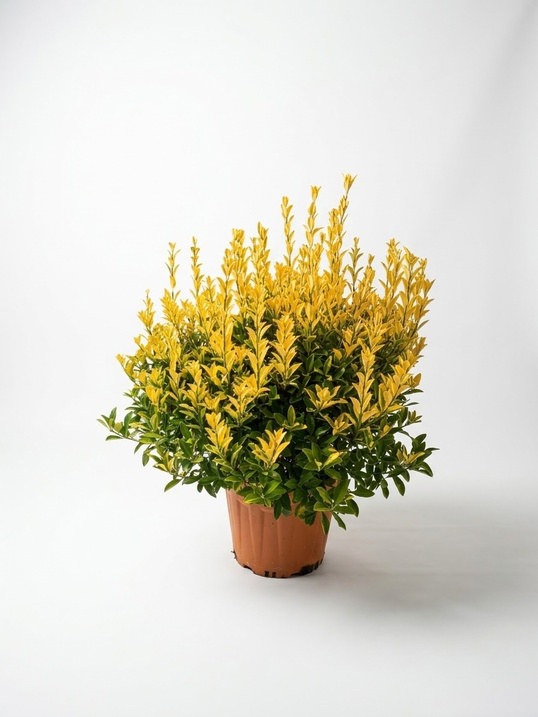
‘El Dorado’ is one of the compact cultivars of Japanese spindle. Its most striking feature is the change in leaf colour: young leaves emerge bright yellow and turn green as they age. This creates a natural colour gradient across the plant, with yellow tips over a green interior, especially during the growing season. From a distance, the ball looks almost as if it were lit from within.
Thanks to its dense, small-scale branching, it holds its rounded shape easily. Being evergreen, it leaves no gaps in containers or borders in winter. Like other Japanese spindle cultivars it is moderately cold-hardy; in harsh continental climates it needs winter protection, especially in small containers.
- Growth: compact, dwarf, slow to moderate
- Foliage: young leaves bright yellow, turning green with age; evergreen
- Light and soil: full sun, well-drained soil
- Safety: parts of the plant, especially the fruit and seeds, can cause poisoning if swallowed; prevent children and pets from putting the plant in their mouths
Ideas for Small Gardens, Balconies and Containers
Its compact habit makes the Euonymus ‘El Dorado’ ball shrub a practical choice for tight spaces. Small sizes can be used on windowsills, in long troughs in front of balcony railings and in tabletop arrangements. Larger sizes are effective as a stand-alone focal point in a front garden or as a pair of containers by the door.
Its yellow-toned leaves pair well with dark green foliage, purple and navy-blue flowers and grey-leaved plants. In winter, when flowers are scarce, it also works as a source of colour in balcony containers.
- A symmetrical pair of containers by the door
- A companion to seasonal flowers in balcony and terrace containers
- A rounded accent in rock and gravel gardens
- Cemetery and small memorial plantings
‘El Dorado’ in Border Planting
A border is a low row of plants edging a path, lawn or flower bed. Dwarf ball shrubs such as ‘El Dorado’ provide rhythmic repetition in a border. Spaced so that they do not touch, the plants create a ‘string of beads’ effect; planted more closely, they gradually merge into a low, undulating band.
When planning a border, set the planting distance according to how wide you want the plants to be within a given number of years. Using plants of the same size makes the layout look balanced from day one. Repeating the same arrangement on both sides of a path makes narrow spaces look tidier and wider.
Planting: A Sunny Spot and Good Drainage
The yellow colour of ‘El Dorado’ shows best in full sun. Grown in shade, new leaves can be paler and the plant may lose its density. So choose a position that gets light for most of the day.
Good drainage is essential. In waterlogged soil the roots can rot. In heavy clay, improve drainage by adding compost and coarse material to the planting hole. Plant at the same level as in the pot, do not bury the root collar, and water thoroughly after planting.
When growing in a container, always use one with drainage holes and add a drainage layer at the bottom. Because small pots dry out quickly and the roots are more easily affected by cold in winter, it is worth potting the plant on by a size or two as it grows.
Watering, Feeding and Light Pruning
Water a newly planted shrub deeply whenever the soil surface dries out. Once established, plants in the ground do not need frequent watering, but container plants, especially on sunny balconies in summer, should be checked every few days. Overwatering is as harmful as drought; do not leave water in the saucer.
A slow-release balanced fertiliser in spring is enough. As a compact plant it does not need heavy feeding; too much nitrogen can lead to loose, leggy shoots.
To keep the ball shape, give it a light trim in spring once the risk of frost has passed and again in early summer. Take off only the tips that stick out of the outline. Because light pruning encourages new shoots, it also refreshes the plant’s yellow-tipped look. Avoid hard pruning in late autumn.
Winter Care and Possible Problems
In cold regions, move container-grown ‘El Dorado’ to a sheltered corner out of the wind, such as against a wall, in winter; wrap the pot and mulch the soil surface. Mulching the root zone of plants in the ground is also beneficial.
The most common problems on Japanese spindle are powdery mildew, scale insects and aphids. Mildew risk increases in dense plantings with poor air circulation. By checking the undersides of leaves and the branches regularly you can spot problems early; if you see widespread damage, get advice from a plant health specialist.
Frequently Asked Questions
Does Euonymus ‘El Dorado’ grow in shade?
It can tolerate light shade to a degree, but its yellow leaf colour and dense habit develop best in full sun. In shade, new leaves may turn pale.
Why are the leaves of ‘El Dorado’ turning green?
This is a natural trait of the cultivar: young leaves emerge bright yellow and turn green as they age. Light pruning encourages new shoots and refreshes the yellow look.
Can it be grown in a container on a balcony?
Yes, its compact habit makes it well suited to balcony and terrace containers. Use a pot with drainage holes, check watering often in summer and protect the container in winter in cold regions.
At Yalova Güven Fidancılık we grow Euonymus japonicus ‘El Dorado’ on our own nursery grounds as a ball form in CLT 2, 5, 10, 12.5 and 18 pot sizes (CLT 18 being an 18-litre pot). This lets you choose the right size for anything from a balcony container to a garden border. For product details see our ‘El Dorado’ product page, and for other plants visit our Products page. Prices and stock availability are available on request — contact us via WhatsApp or by phone on +90 543 941 88 77.
Yalova Güven Fidancılık
Grown at our own nursery — see forms, pot sizes and heights on the product page.