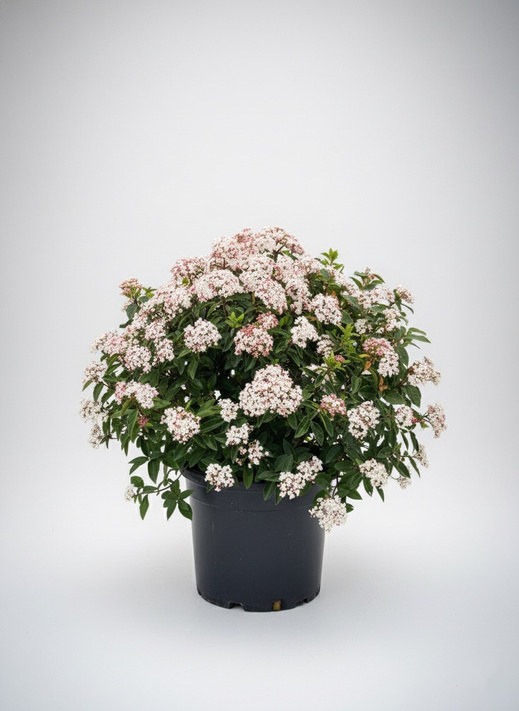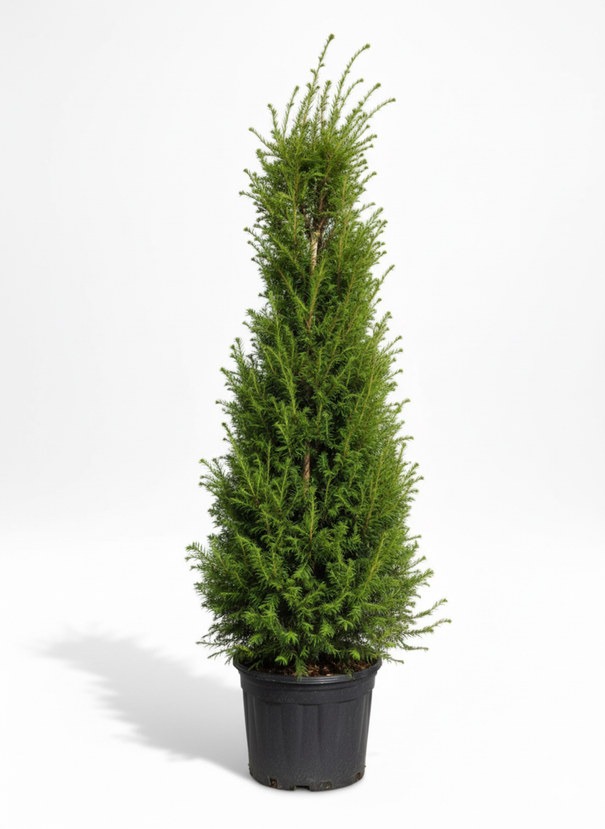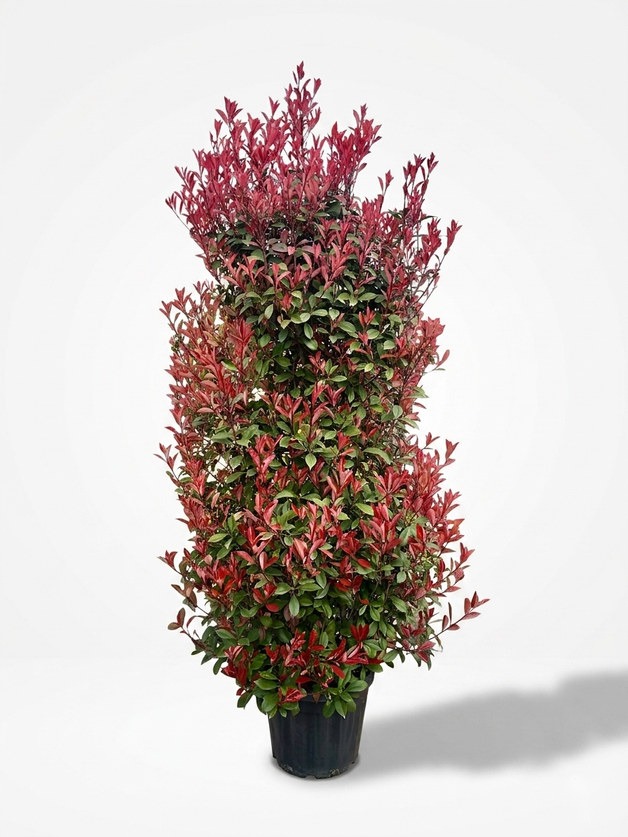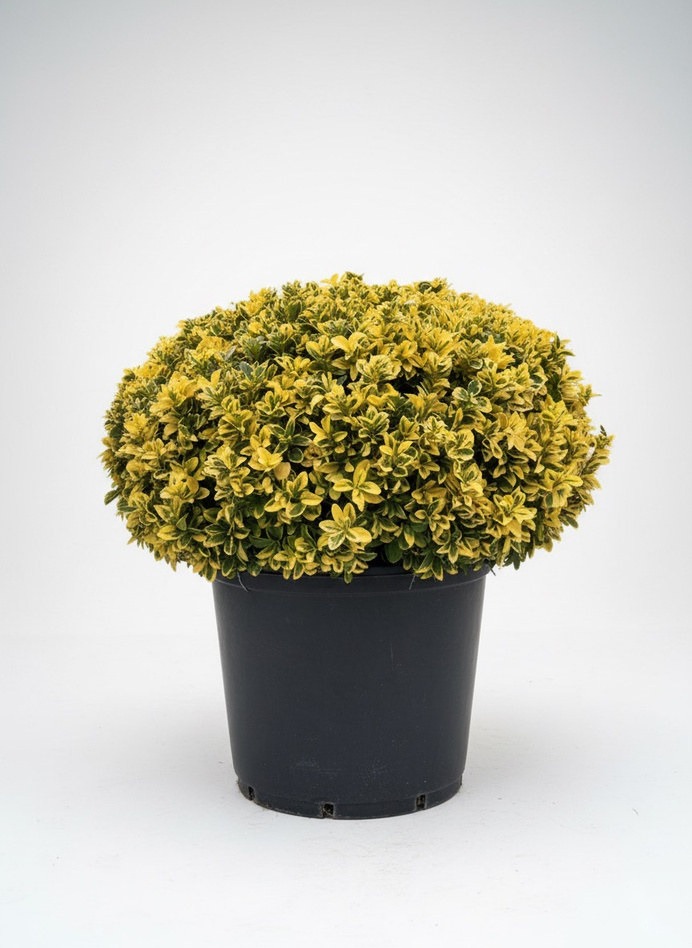
Japanese spindle is one of the go-to shrubs for anyone who wants year-round colour in the garden. The ‘Aureus’ cultivar of Euonymus japonicus, with its variegated leaves blending yellow and green, keeps the garden lively even in winter. Its dense branching makes it easy to shape with shears, which is why nurseries most often grow it as balls and pyramids.
In this guide we walk through Japanese spindle care step by step: choosing the right spot, planting, watering and feeding, pruning techniques for ball-shaped topiary, and common problems. Our aim is to help you keep your shaped plant looking as crisp as the day it arrived for many years to come.
What Kind of Plant Is Euonymus japonicus ‘Aureus’?
Euonymus japonicus is an evergreen shrub native to East Asia. In ‘Aureus’, the leaf centres and margins are variegated in different shades of yellow and green. The glossy, leathery, slightly thick leaves stay on the branches all year round, which makes the plant valuable for winter gardens.
Left to itself, the plant grows into an upright, dense shrub. Because it responds well to pruning, it is easily trained into balls, pyramids and standards (clear-stemmed tree forms). It generally copes well with coastal winds and urban conditions. It is moderately cold-hardy, but in harsh continental climates it needs winter protection, especially when grown in containers.
- Foliage: yellow-and-green variegated, glossy, evergreen
- Light: full sun or partial shade
- Uses: ball and pyramid forms, standards, low hedges, containers
- Safety: parts of the plant, especially the fruit and seeds, can cause poisoning if swallowed; keep young children and pets from putting the plant in their mouths
Using Ball and Pyramid Forms in the Landscape
Shaped plants bring order and rhythm to a garden. Set at regular intervals along a border, a ball-form Japanese spindle defines a pathway, and repeating rounded outlines over gravel or lawn create a calm look. Smaller sizes suit containers and balcony schemes, while larger sizes work well as focal points in bigger gardens.
A pyramid-form Euonymus ‘Aureus’, on the other hand, adds a vertical accent. Used symmetrically on either side of an entrance, at the top of steps or at the corners of low hedges, it creates a classic, formal feel. For something more decorative, the braided-stem standard, with its intertwined trunk and rounded crown, makes an eye-catching statement on terraces and in containers.
The yellow-toned foliage contrasts beautifully with dark green ground cover and with grey stone or anthracite planters. In shady corners, the variegated leaves have a brightening effect.
Planting: Site Selection and Soil Preparation
‘Aureus’ grows in full sun or partial shade. To keep the leaf colour vivid, choose a position that gets at least a few hours of light a day; in deep shade the variegation can fade and the branches can thin out.
The soil must be well drained. In heavy, waterlogged clay the risk of root rot increases. Dig a planting hole roughly twice the width of the root ball and mix the excavated soil with well-rotted compost. Set the plant at the same level it sat in its pot, without burying it deeper, and water it in thoroughly after planting.
If you are growing it in a container, choose one a size or two larger than its current pot, with drainage holes. A drainage layer at the bottom and a good-quality, free-draining potting mix will keep the roots healthy.
- Best planting time: spring and autumn
- Container-grown plants can be planted for most of the year, as long as the ground is not frozen
- If you plant in summer heat, do not skip watering during the first few weeks
Watering and Feeding
A newly planted Japanese spindle needs regular watering in its first year. Watering deeply once the top few centimetres of soil have dried out is better than frequent, shallow watering. Established plants can tolerate drought to a degree, but checking them weekly during long, hot summers is still important.
Container plants dry out much faster than those in the ground. Check the potting mix often in summer, but do not let water stand in the saucer. For feeding, a slow-release balanced fertiliser applied in spring as growth begins is enough. Stopping nitrogen feeding after late summer prevents the plant from going into winter with soft new shoots.
Caring for Ball-Shaped Topiary: Pruning and Keeping the Form
The secret to keeping balls and pyramids neat is regular, light trimming rather than occasional hard pruning. The main pruning is done in spring once the risk of frost has passed. One or two light touch-ups in early and mid-summer keep the outline crisp.
For a ball, walk around the plant and trim the same amount from every side. Taking only the tips of new shoots encourages denser growth towards the inside. For a pyramid, make sure the base stays slightly wider than the top; this way the lower branches keep receiving light and the plant does not go bare at the bottom.
Variegated cultivars occasionally produce shoots with entirely green leaves. Because these grow more vigorously, they can spoil both the shape and the colour over time; cut them out at their point of origin as soon as you spot them.
- Use sharp, clean shears and avoid crushing the leaves
- Avoid pruning during the hottest hours of the day
- Do not prune hard in late autumn; new shoots will go into winter unprepared
- A light watering after trimming helps the plant recover
Winter Preparation and Common Problems
In mild climates, Japanese spindle planted in the ground usually comes through winter without trouble. In colder regions, and especially in containers, the roots are more vulnerable to frost; moving the pot to a sheltered spot such as against a wall, wrapping the pot and mulching the surface all help. Dry, cold winds can scorch the leaves.
Common problems include powdery mildew, scale insects and aphids. Powdery mildew usually appears in shady, humid spots with poor air circulation; leaving enough space between plants and not wetting the foliage in the evening reduces the risk. Scale insects show up as small shell-like bumps on stems and the undersides of leaves; if caught early, the affected parts should be cut out and a suitable control method applied. In serious cases, it is best to consult a plant health specialist.
Frequently Asked Questions
Does Japanese spindle grow in shade?
It grows happily in partial shade. However, for variegated cultivars such as ‘Aureus’, the plant should get some light during the day to keep the leaf colour vivid; in deep shade the colour can fade.
How many times a year should a ball-shaped plant be pruned?
Usually one main pruning in spring and one or two light touch-ups over the summer are enough. Hard pruning in late autumn should be avoided.
Is Japanese spindle poisonous?
Yes, parts of the plant, especially the fruit and seeds, can cause poisoning if swallowed. Young children and pets should not be allowed to put the plant in their mouths.
Why are the variegated leaves turning green?
Variegated cultivars occasionally produce all-green shoots. Cutting these out at their point of origin preserves the variegated look. Too much shade can also cause the colour to fade.
At Yalova Güven Fidancılık we grow Euonymus japonicus ‘Aureus’ on our own nursery grounds in three forms: ball form (CLT 5, 9, 18, 35, 55, 110 and 160 — CLT 18 being an 18-litre pot), pyramid form (CLT 18, 35, 55 and 110; 140–200 cm tall) and braided-stem standard (CLT 18; 140–180 cm tall). For other shaped plants, browse our Products page. Prices and stock availability are available on request — contact us via WhatsApp or by phone on +90 543 941 88 77.
Yalova Güven Fidancılık
Grown at our own nursery — see forms, pot sizes and heights on the product page.