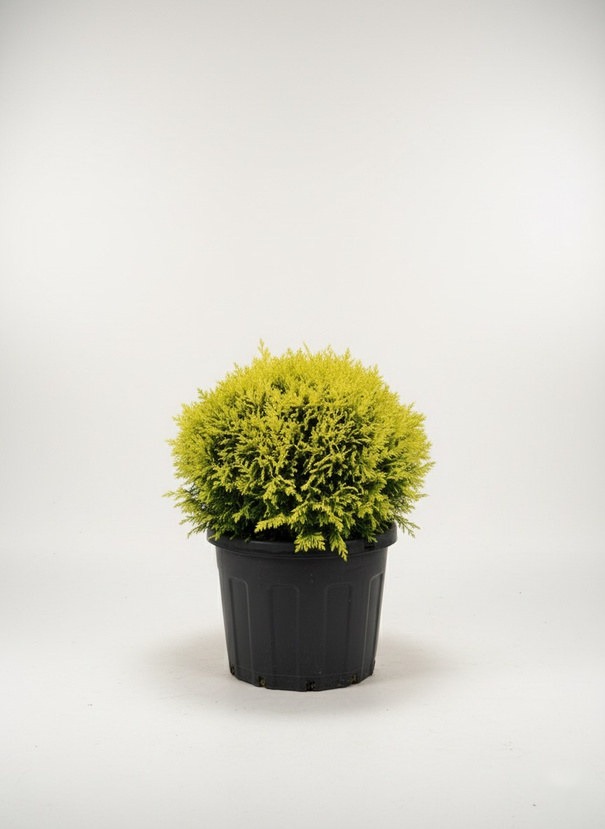
In a garden dominated by green, or on a simple terrace, a golden plant that catches the light can bring the whole scheme to life. Cupressus macrocarpa ‘Goldcrest’, better known as lemon cypress, creates exactly that effect with its fine, soft-textured golden-yellow foliage. The fresh lemon scent released when you touch or lightly crush the foliage is what gives it its name.
As eye-catching as it is, lemon cypress is sensitive in some respects: it reacts both to drying out and to overwatering, and under the wrong conditions its interior can turn brown. In this guide we cover lemon cypress care, focusing especially on container and ball-form use.
Features of Lemon Cypress
‘Goldcrest’ is a golden-leaved cultivar of Monterey cypress. Its foliage is fine, soft and feathery; from the outside the plant looks a bright, almost luminous yellow-green. It is evergreen and naturally tends towards an upright, pointed form; with regular trimming it can also be grown in other shapes, such as a ball.
The intensity of the golden colour depends on light. The brightest yellow tones appear in full sun; in shade the colour turns green and the foliage can become sparse.
- Foliage: fine, soft, golden-yellow; lemon-scented when touched
- Light: full sun
- Soil: well drained, not waterlogged
- Sensitivities: drought, overwatering, cold and drying winds
Using It in Containers and Gardens
Ball-form lemon cypress is particularly effective in containers. On either side of an entrance, in balcony and terrace corners, or in container groupings with dark-coloured plants, it provides a strong splash of colour. In the garden, it can be used in front of dark green or purple-leaved plants, in gravel gardens and as a repeated element in formal schemes.
Because of its scent, positions near seating areas and paths are also a good choice; even brushing it lightly as you pass is enough to release the lemon fragrance. You can see the ball-form options on our lemon cypress ‘Goldcrest’ product page.
The Right Position and Planting
The two most important requirements for lemon cypress are full sun and good drainage. Place the plant somewhere that gets sun for most of the day but is sheltered from cold, drying winds. Exposed corners with constant wind and roof terraces can cause leaf scorch unless protective measures are taken.
When planting in the garden, avoid heavy, water-retentive soils or improve them with organic matter and coarse sand. Do not bury the root ball deeper than ground level. When growing in a container, use a pot with drainage holes, slightly wider than the root ball, and a fast-draining mix; do not let water collect at the bottom of the pot.
Watering: The Most Critical Point
The most common mistakes in lemon cypress care relate to watering. If the root ball dries out completely, it can cause sudden browning, and the dried-out parts do not always recover. On the other hand, soil that stays constantly wet causes root rot. The aim is to keep the soil evenly and slightly moist.
A practical method is to check the top few centimetres of the potting mix with your finger: if it has started to dry, water until water runs out of the bottom of the pot; if it is still moist, wait. Container plants can dry out very quickly in summer heat and on windy days, so they should be checked more often. Water needs fall in winter, but on dry, windy winter days make sure the potting mix does not dry out completely.
Feeding and Pruning
A balanced, slow-release fertiliser applied in spring is usually enough for the growing season. Because nutrients are gradually washed out of containers, a moderate supplementary feed can be given during the growing season. Stop feeding after late summer.
To keep the ball shape, lightly trim the tips of the green shoots in late spring and through the summer. The most important rule here is this: like many cypresses, lemon cypress generally does not reshoot from bare, brown old wood. So always leave your cuts within the foliage and avoid hard pruning. Frequent, light trimming gives far better results than occasional hard pruning.
Browning, Winter and Common Problems
Some browning in the interior of a lemon cypress may not be a cause for concern on its own; older inner foliage that gets no light can naturally dry out over time. However, brown patches spreading across the outer surface are usually a sign of stress. Common causes include the root ball drying out, overwatering and poor drainage, cold and drying winds, and poor air circulation.
Lemon cypress is moderately cold-hardy; in harsh continental climates it should be moved to a sheltered spot. In winter it helps to move container plants to places out of the wind, such as against a wall, and to insulate the pot. If you see dieback progressing along the branches, the best approach is to remove the dead parts back to healthy tissue and, if the problem continues, consult a plant protection specialist.
Frequently Asked Questions
Why is my lemon cypress turning brown?
The most common causes are the root ball drying out, overwatering and waterlogging, cold and drying winds, and insufficient light. Some drying of older foliage in the interior is natural.
Can lemon cypress grow indoors?
It is not suited to long-term indoor conditions. It is an outdoor plant that needs plenty of sun and fresh air; it can be kept indoors briefly as a decoration but should be moved to a bright outdoor spot as soon as possible.
Does lemon cypress grow in shade?
It can survive in light shade, but the golden colour fades, the foliage turns green and becomes sparse. Full sun is preferred for the best appearance.
Will browned branches turn green again?
Usually not. Lemon cypress does not readily reshoot from bare, brown parts. That is why prevention — regular, balanced watering and a sheltered position — is so important.
At Yalova Güven Fidancılık, lemon cypress (Cupressus macrocarpa ‘Goldcrest’) is grown on our own nursery grounds as a ball form in CLT 35 (35-litre) pots. You can browse our other shaped plants on our Products page. Prices and stock availability are available on request — contact us via WhatsApp or by phone on +90 543 941 88 77.
Yalova Güven Fidancılık
Grown at our own nursery — see forms, pot sizes and heights on the product page.