When you want a single plant to define an entire terrace, building entrance or courtyard, you need one with strong colour and form. Loropetalum chinense ‘Black Pearl’, a Chinese fringe flower with dark purple-brown leaves that are almost black and pink, fringe-like flowers that glow against this dark backdrop, takes on exactly that role.
What makes this cultivar especially valuable is the architectural effect it offers in shaped forms such as the standard and the bonsai form. In this article we look at how to use ‘Black Pearl’ as a focal plant, how to grow it in a container and how to keep its shape over the years.
What Makes ‘Black Pearl’ Different
‘Black Pearl’ is one of the darkest-leaved loropetalum cultivars. The leaves appear in a shade between purple and brown that deepens depending on the light. During flowering, bright pink, fringe-like flowers made of fine strap-shaped petals create a strong contrast against this dark foliage.
It remains evergreen in mild conditions, but in cold winters or in positions exposed to cold wind it may drop some of its leaves. This is usually temporary, and the plant recovers with new shoots in spring. Even so, for specimens used as focal plants, care should be taken in choosing the site to preserve their winter appearance.
Standard Form: Colour at Eye Level
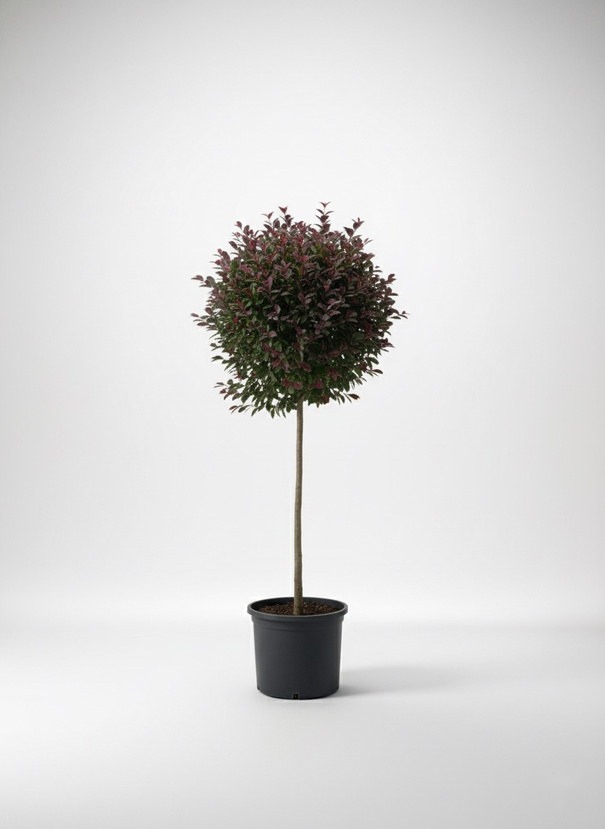
A standard is a plant grown on a single straight trunk so that it forms a rounded crown at the top. A ‘Black Pearl’ standard of around 150–180 cm raises its dark crown to eye level and lets you use the space left free underneath for other plants.
Standards are especially effective in symmetrical schemes. A pair of standards placed on either side of a door frames the entrance, while standards repeated at regular intervals along a long path create an orderly rhythm. Planting trailing or low seasonal plants, or light-coloured ground cover, at the base of the container creates an attractive layered contrast with the dark crown.
- A symmetrical pair on either side of the front door
- A focal plant in terrace corners and seating areas
- A repeating rhythm along paths and pool edges
- A signature plant at commercial premises, hotels and residential complex entrances
Bonsai Form: A Large-Scale Sculpture
The bonsai form referred to here is not a miniature tabletop bonsai. It is a large garden and terrace plant, 150–180 cm tall, whose trunk and branch structure has been shaped in layers following bonsai aesthetics. Because each plant’s branch arrangement is slightly different, every specimen has its own character.
Placing a bonsai-form ‘Black Pearl’ against a plain backdrop, such as a light-coloured wall, gravel or a simple lawn, makes its branch structure and dark leaf clusters easier to read. It creates a strong focal point in Japanese-inspired gardens, modern minimalist landscapes and inner courtyards. You can see the available forms on the Loropetalum ‘Black Pearl’ product page.
Growing in Containers: Position, Pot and Potting Mix
‘Black Pearl’ reaches its darkest leaf colour and most abundant flowering in full sun; in shade the leaves may shift to a greener tone. The position you choose should be sunny but sheltered from cold, drying winds. Spots in front of walls and corners protected from the wind are ideal in this respect.
The container should be slightly wider than the root ball and must have drainage holes. For tall standards and bonsai forms, heavy, wide-based pots reduce the risk of being blown over. For the potting mix, choose a slightly acidic blend that holds moisture but drains excess water quickly; a mix with added peat or compost, opened up with perlite or fine grit, is suitable. Standing the pot on feet prevents the drainage holes from becoming blocked.
Watering and Feeding
Because the roots of a container plant rely solely on the volume of the pot, attention must be paid to watering. When the top of the potting mix starts to dry, water deeply until water runs out of the bottom of the pot. This need becomes more frequent in summer heat and drops noticeably in winter. Soil that stays constantly wet can lead to root rot, while soil that dries out completely can cause leaf drop.
For feeding, a slow-release fertiliser suitable for acid-loving plants can be used in spring. Because nutrients in the pot are gradually washed out by watering, a supplementary feed at the manufacturer’s recommended dose can be given during the growing season. Stop feeding after late summer so the plant goes into winter with ripened shoots.
Pruning to Maintain the Form
The value of a shaped plant depends on its form being maintained. Carry out the main pruning after the spring flowering has finished; because loropetalum forms its flower buds on the previous year’s shoots, late pruning can reduce the following year’s flowers. During the growing season, lightly shortening long shoots that stick out of the crown keeps the form tidy.
- On standards, remove shoots appearing along the trunk and at the root collar as soon as you see them.
- Keep the rounded outline of the crown while thinning the inside slightly; this improves air circulation.
- On bonsai forms, preserve the gaps between branch layers; remove shoots that link the layers together.
- Secure tall-stemmed plants with a support stake in the first years and check that ties are not constricting the trunk.
Winter and Possible Leaf Drop
Loropetalum is moderately cold-hardy, but roots in containers are more exposed to freezing cold than those in the ground. In harsh continental climates it is advisable to move pots against a wall, insulate the pot and protect the crown from cold winds. There is no need to panic over some leaf loss in winter; in spring, checking how the plant is reshooting and removing damaged branch tips is usually enough.
Frequently Asked Questions
How big does a standard loropetalum grow?
In a standard, height is largely determined by the height of the trunk, while the crown is kept to the desired size by regular pruning. Without pruning, the crown widens over time and the form is lost.
Can a bonsai-form ‘Black Pearl’ grow indoors?
It is not recommended. This is an outdoor plant that needs plenty of sun and fresh air. Indoors, insufficient light causes its colour to fade and the plant to weaken. An enclosed but bright conservatory can be a temporary solution.
Why does ‘Black Pearl’ drop leaves in winter?
Although it stays evergreen in mild conditions, it can drop leaves in cold winters and in positions exposed to cold wind. The plant usually reshoots in spring; a sheltered position reduces this loss.
Should I cut off shoots growing from the trunk of a standard?
Yes. Shoots from the trunk and root collar divert the plant’s energy away from the crown and spoil the form. Remove them at the base as soon as they appear.
At Yalova Güven Fidancılık, Loropetalum ‘Black Pearl’ is grown on our own nursery grounds in the following forms: 150–180 cm standard in CLT 18 (18-litre) pots, ball form in CLT 35 pots and 150–180 cm bonsai form in CLT 110 pots. For our other shaped plants, see our Products page. Prices and stock availability are available on request — contact us via WhatsApp or by phone on +90 543 941 88 77.
Yalova Güven Fidancılık
Grown at our own nursery — see forms, pot sizes and heights on the product page.