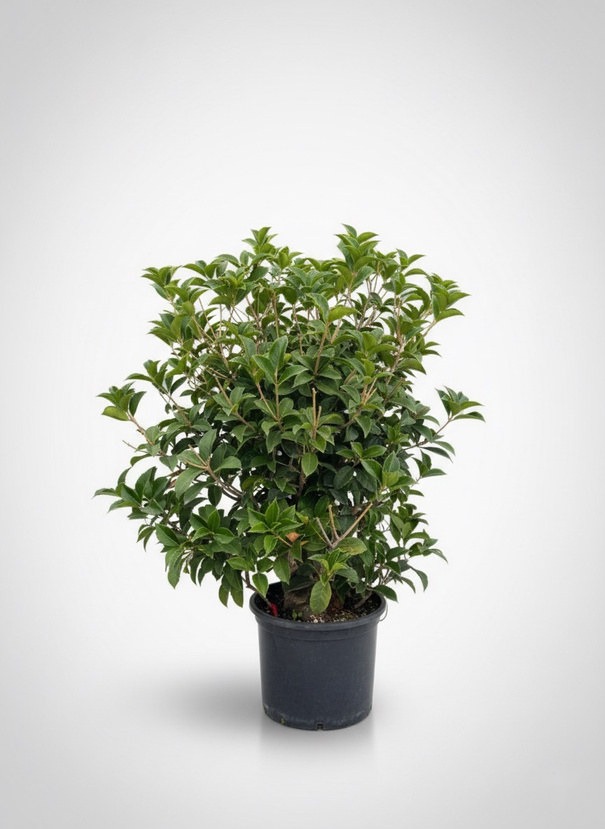
If you are looking for a dense, low-maintenance plant that stays green all year, Osmanthus heterophyllus should be near the top of your list. Known as osmanthus or false holly, this shrub has glossy, spiny-edged leaves that look very much like holly at first glance. What really makes it special, though, are the small white flowers that open in autumn, when many plants have finished flowering, and the sweet fragrance they spread through the garden.
In this guide we cover osmanthus care from every angle: from the plant’s features and its use as a hedge or screen to planting, watering, pruning and common problems, explained in plain language.
Getting to Know Osmanthus heterophyllus
Osmanthus heterophyllus is an evergreen shrub native to East Asia. Its English name, false holly, comes from the resemblance of its leaves to those of Ilex species. There is a practical way to tell the two apart: osmanthus leaves are arranged in opposite pairs along the stem, whereas holly leaves are alternate.
The species name “heterophyllus” means “with different leaves”. Young plants have distinctly spiny leaf margins, while older plants, especially on the upper branches, may show leaves with smoother edges. The plant forms a dense, full shape, and its growth rate is generally slow to moderate.
- Evergreen, glossy dark green leaves
- Small, white, fragrant flowers in the leaf axils in autumn
- Densely branching habit that responds well to pruning
- Spiny leaves that form a natural protective barrier
Garden and Landscape Uses: Hedge, Screen and Shaped Specimen
Thanks to its dense foliage, osmanthus is most often chosen as a hedging and screening plant. It is ideal for creating a visual screen, and to some extent a windbreak, along a neighbour’s boundary, beside a car park or in residential complex gardens. Because its spiny leaves make the hedge hard to push through, it is also an advantage for security-minded boundary planting.
Since it is easily shaped by pruning, it can also be used as a specimen plant in a neat ball or cube form. Placed on either side of an entrance, near seating areas or in large containers on terraces, it lets you make the most of its autumn fragrance. You can view the different sizes available for landscape projects on our Osmanthus heterophyllus product page.
Planting: Site Selection and Soil Preparation
Osmanthus grows well in full sun or partial shade. In full sun it tends to be denser and more free-flowering; in hot, dry regions, positions with light afternoon shade protect the leaves from scorching sun.
It is not fussy about soil, but it likes soil that holds moisture while also draining well. In heavy, water-retentive clay, mixing well-rotted compost and coarse sand or perlite into the planting hole reduces the risk of root rot.
Container-grown plants can be planted for most of the year except on hot summer days; autumn and spring are the best times. Dig a planting hole roughly twice the width of the root ball, set the plant at the same level it sat in the pot and water it in thoroughly after planting. When planting a hedge, spacing the plants evenly along a line produces a continuous green wall within a few years.
Watering and Feeding
A newly planted osmanthus needs regular watering throughout its first growing season. Watering deeply as the top layer of soil dries out encourages the roots to grow downwards. Once the root zone is established, the plant copes reasonably well with short dry spells, though an occasional deep watering is still helpful during long, hot summers.
Container-grown plants dry out faster than those in the ground; check the potting mix often in summer, but do not let water collect at the bottom of the pot. For feeding, a balanced, slow-release fertiliser in spring or well-rotted compost spread over the root zone is usually enough. Fertiliser that is too high in nitrogen can favour leaf growth over flowers.
Pruning and Maintaining the Form
Osmanthus responds very well to pruning, so it can easily be used in both natural and geometric forms. To keep a neat ball or hedge shape, the main pruning is best done between late spring and early summer. This timing gives new shoots time to mature before autumn flowering.
On hedges, keeping the base slightly wider than the top ensures the lower branches also get light and the hedge does not thin out at the bottom. Dead, damaged or misshapen branches can be removed at any time of year. Because of the spiny leaves, we recommend wearing thick gloves when pruning.
- Main shaping prune: late spring to early summer
- A light tidy-up in late summer if needed
- Avoid hard pruning in autumn; it can reduce flowering
- Keep cutting tools sharp and clean
Winter Preparation and Common Problems
Osmanthus heterophyllus is moderately to fairly cold-hardy and usually comes through winter without trouble in mild climates. In harsh continental climates, however, young plants and those in containers in particular should be protected from cold, drying winds. Mulch spread over the root zone protects the soil from cold in winter and from excessive evaporation in summer.
It is generally a healthy plant. The most common problems are root rot caused by constantly wet soil and, occasionally, pests such as scale insects. If you notice yellowing leaves, first check the drainage and how often you are watering; if pests are present, intervene early with a suitable plant protection method.
Frequently Asked Questions
When does Osmanthus heterophyllus flower?
It usually flowers in autumn. The flowers are small and white, form in clusters in the leaf axils and give off a sweet scent that you notice as you walk past.
How can you tell osmanthus from holly?
The most practical way is to look at the leaf arrangement. Osmanthus leaves are opposite on the stem, while holly leaves are alternate. Osmanthus also bears fragrant white flowers in autumn.
Is osmanthus suitable as a hedging plant?
Yes. Its dense habit, evergreen leaves and good response to pruning make it very well suited to regularly clipped hedges and privacy screens.
Does osmanthus grow in shade?
It grows happily in partial shade. In full shade, growth may slow and flowering may decrease; it performs best in full sun or partial shade.
At Yalova Güven Fidancılık we have been growing Osmanthus heterophyllus on our own nursery grounds in Yalova since 2005, and we supply our plants in CLT 18 (18-litre) and CLT 35 pot sizes. For product details visit our osmanthus product page, and for other plants see our Products page. Prices and stock availability are available on request — contact us via WhatsApp or by phone on +90 543 941 88 77.
Yalova Güven Fidancılık
Grown at our own nursery — see forms, pot sizes and heights on the product page.